
The second edition of Martin Fowler's bestselling
UML Distilled provides updates to the Unified Modeling Language (UML) without changing its basic formula for success. It is still arguably the best resource for quick, no-nonsense explanations of using UML.
The major strength of UML Distilled is its short, concise presentation of the essentials of UML and where it fits within today's software development process. The book describes all the major UML diagram types, what they're for, and the basic notation involved in creating and deciphering them. These diagrams include use cases; class and interaction diagrams; collaborations; and state, activity, and physical diagrams. The examples are always clear, and the explanations cut to the fundamental design logic.
For the second edition, the material has been reworked for use cases and activity diagrams, plus there are numerous small tweaks throughout, including the latest UML v. 1.3 standard. An appendix even traces the evolution of UML versions.
Working developers often don't have time to keep up with new innovations in software engineering. This new edition lets you get acquainted with some of the best thinking about efficient object-oriented software design using UML in a convenient format that will be essential to anyone who designs software professionally. --Richard Dragan
Topics covered: UML basics, analysis and design, outline development (software development process), inception, elaboration, managing risks, construction, transition, use case diagrams, class diagrams, interaction diagrams, collaborations, state diagrams, activity diagrams, physical diagrams, patterns, and refactoring basics. --This text refers to an out of print or unavailable edition of this title.
- Paperback: 208 pages
- Publisher: Addison-Wesley Professional; 3 edition (Sep 25 2003)
- Language: English
- ISBN-10: 0321193687
- ISBN-13: 978-0321193681
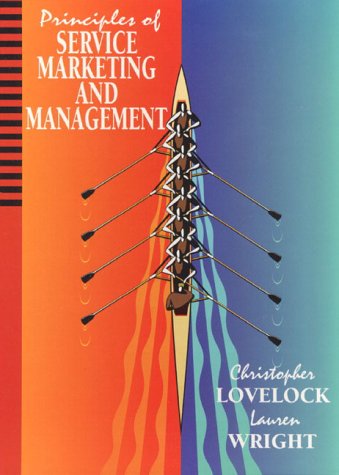 Principles of Service Marketing and Management, Second Edition, is designed to complement the materials found in traditional marketing principles texts. It avoids sweeping and often misleading generalizations about services, recognizing explicitly that the differences between specific categories of services (based on the nature of the underlying service process) may be as important to student understanding as the broader differences between goods marketing and services marketing.


